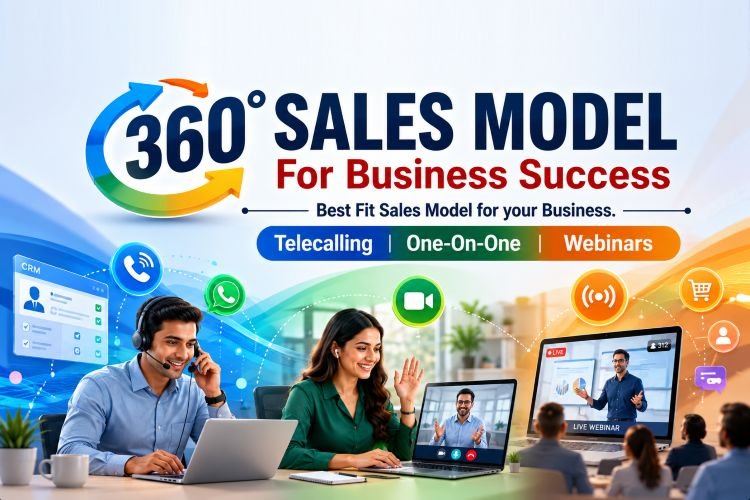
Which sales model should a business pick? Most businesses do not fail because they lack leads. They struggle because they use the wrong conversion process.
A founder sees another company running webinars and assumes webinars are the answer. A consultant starts telecalling because everyone else does. A service provider books meetings for every prospect and then wonders why growth feels slow.
But customer acquisition is not one-size-fits-all.
The real question is: How much trust does your customer need before making a purchase?
That answer determines whether telecalling, one-to-one meetings, or webinars make the most sense and how those models should work together.
1. Telecalling Sales Model – When Human Follow-Up Wins
Typical flow: Lead → CRM → WhatsApp → Staff Calls → Qualify → Pitch → Close
Telecalling is a structured outbound sales process where a team actively follows up with potential customers. Conversations happen early, before a prospect has had time to disengage or forget why they showed interest in the first place.
Telecalling Sales Model Best suited for:
- Local services
- Real estate
- Education counseling
- Insurance
- Healthcare consultations
- Businesses with large lead volumes and lower-ticket offers
Sales Model Strengths:
- Immediate interaction with a live prospect
- Easier objection handling in real time
- Faster qualification – you identify serious buyers quickly
- Works well where speed-to-contact drives conversion rates
The real challenge most miss:
Bad telecalling does not just fail to convert – it actively destroys trust.
A prospect who receives three aggressive follow-up calls in 48 hours, gets read from a script, or feels pressured into a decision is not just lost. They may leave a bad review, warn others, or simply block your number. The downside of poor execution is not zero – it is negative.
This means telecalling only works when your team is trained well enough to hold genuine, helpful conversations. Not to pitch. Not to “handle objections.” But to listen, qualify honestly, and guide the right people toward the next step.
If your team cannot do that consistently, telecalling scales your damage faster than it scales your revenue.
Telecalling Sales Model Example:
A training institute receives 500 leads monthly. Calling all 500 may help identify the 50 genuinely interested prospects – but only if callers are skilled enough to have real conversations and honest enough to disqualify people who are not a fit.
2. Sales Model Virtual One-to-One, When Trust Closes Deals
Typical flow: Lead → Book Demo → Zoom/Google Meet → Close on Call
This model moves customers into a scheduled, intentional conversation. Instead of chasing people, prospects choose to engage. That shift in dynamics from outbound to opt-in changes everything.
Virtual One-to-One Sales Model Best suited for:
- Consulting
- SaaS and software products
- Agencies
- Freelancers and independent service providers
- Coaching
- Any high-value service where the buyer is choosing a person, not just a product
Strengths:
- Higher intent audience; they booked, so they are already interested
- Deeply personalized; you can adapt the conversation in real time
- Better for premium pricing, because you can demonstrate value directly
- Shorter sales cycles when done well
The real challenge most miss:
Time is the hard ceiling.
One-to-one meetings cannot scale beyond your available hours. A consultant running 8 demos a day cannot run 80, no matter how efficient the process becomes. This creates a trap: as demand grows, the bottleneck shifts from lead generation to the capacity of founders or sales reps.
The solution is not to skip one-to-one meetings. It is to use them selectively for prospects who are genuinely qualified and likely to convert at a price point that justifies the time invested. Booking a 60-minute demo for every inbound lead regardless of fit is a fast path to burnout.
Virtual One-to-One Sales Model Example:
A web development agency may convert far better from 10 qualified demos than 100 cold calls. The issue is not the model it is whether those 10 demos are with the right 10 people.
3. Sales Model Webinars When Scale Matters
Typical flow: Lead → Register → Attend → Buy or Book Call
Webinars educate before selling. Instead of repeating the same pitch to each prospect individually, you explain it once to many and let the content do the qualifying work before any conversation happens.
Webinars Sales Model Best suited for:
- Online courses and membership programs
- Digital products
- Communities
- High-ticket coaching
- Any business where prospects need to understand a new concept before they can buy
Strengths:
- Scalable: the same session can reach 10 or 10,000 people
- Builds authority and positions you as a credible expert
- Low-pressure environment buyers can decide without feeling pushed
- Efficient when you find yourself repeating the same explanations across individual calls
The real challenge most miss:
Webinars are not a lead-generation strategy but a conversion strategy for an existing audience.
“Requires audience building” underestimates what this actually means. Running a webinar to a cold list of 50 people you just acquired will convert very differently from running one to a warm community of 5,000 followers who already trust your thinking. The gap between those two scenarios is months or years of consistent content, relationship-building, and showing up before you have anything to sell.
Businesses that fail with webinars usually have the mechanics right and the audience wrong. They run the perfect hour-long session to people who have no idea who they are. The webinar itself is not the problem.
Additionally, live attendance rates have declined significantly. Many businesses now use webinars as on-demand evergreen content or automated sequences rather than live events — which changes the dynamic considerably.
Webinars Sales Model Example:
A business coach with an established audience may present to 300 attendees and convert 15 buyers. A coach with a brand-new list may present to 12 people and convert one. Same webinar. Very different results.
Comparison at a Glance
| Factor | Telecalling | One-to-One | Webinar |
|---|---|---|---|
| Human Effort | High | Medium | Low (once built) |
| Personalization | High | Very High | Medium |
| Scalability | Low | Medium | High |
| Trust Building | Medium | Very High | High |
| Setup Complexity | Medium | Low | High |
| Cost Per Lead | Medium | Medium | Low at scale |
| Risk of Misuse | High | Low | Low |
| Audience Requirement | Low | Low | High |
So Which Sales Model Should You Choose?
Choose Telecalling if:
- You have many leads coming in and need to qualify them fast
- Your offer is in a sector where buyers expect a conversation (insurance, real estate, education)
- You have the team and training budget to do it well – not just the headcount
Choose One-to-One if:
- Your average deal value is high enough to justify the time
- Trust and relationship drive the buying decision
- Buyers are choosing you as much as your service
Choose Webinars if:
- You already have an engaged audience or a strong content presence
- You find yourself repeating the same educational pitch across individual calls
- You want to scale conversion without scaling your time proportionally
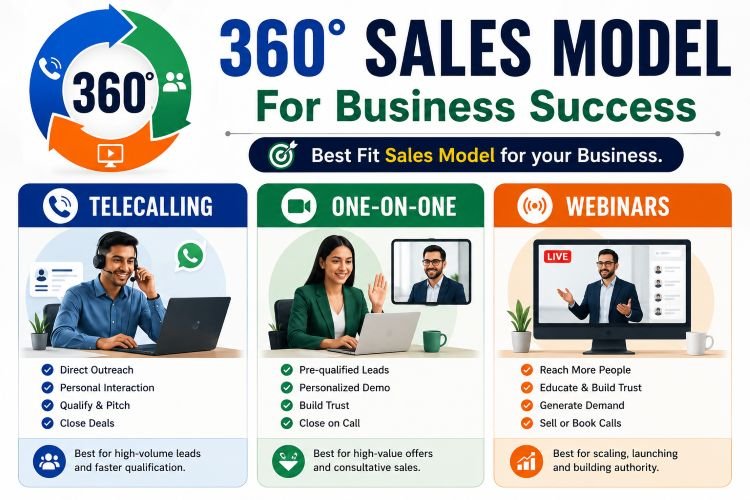
The Real Answer: The Hybrid Sales Model Is the Strategy
Treating telecalling, one-to-one meetings, and webinars as three separate options misses the bigger picture. In practice, the most effective businesses use all three sequenced in the right order for the right type of prospect.
The models are not alternatives. They are stages.
Common hybrid sequences:
Volume → Qualification → Conversion: Lead → Telecalling (qualify) → Demo Call (convert)
This works well for SaaS, agencies, and education where telecalling handles the filtering work, and one-to-one meetings close the right prospects at the right time.
Authority → Engagement → Sale: Content → Webinar → Book Call → Close
This works well for coaches, consultants, and course creators where the webinar does the heavy lifting of education and objection-handling, and the follow-up call is just confirmation.
High Volume → Broadcast → Personal: Ads → Webinar → Telecalling for no-shows → Demo for engaged prospects
This hybrid treats different segments of the same lead pool differently based on their behavior maximizing conversion across the full funnel.
The key principle:
Different prospects require varying levels of trust before they will buy.
The job of a well-designed sales process is to move each type of prospect through the right combination of touchpoints not to force everyone through the same funnel regardless of where they are in their decision-making.
The customer does not care about your sales model. They care whether they understand what you are offering, whether they trust you enough to try it, and whether the buying process felt worth their time.
Build the process that creates that trust. Because the best sales model is not the one with the fewest steps, or the one that worked for someone else’s business.
It is the one that moves your specific customers from curiosity to confidence in a way that scales without breaking.
The right model for your business today may not be the right model in 12 months. As your audience grows and your brand strengthens, your optimal mix will shift. Revisit the question regularly.
By Author: I have seen it all. If you want to bounce ideas, questions, or thoughts, you can reach me on my LinkedIn profile or write back to the team.