Why right headlines can be the difference between being ignored and getting hired.
Imagine spending five hours creating the perfect portfolio.
You carefully choose your best work. You write about your experience. You highlight your skills. You publish your website, proud of what you’ve built.
Then… nothing happens.
- No inquiries.
- No messages.
- No clients.
Most freelancers assume the problem is their work. But often, the problem starts much earlier. People never made it past the first line.
Before someone reads your portfolio, proposal, blog post, LinkedIn article, email, or advertisement, they make a split-second decision:
“Is this worth my time?”
That decision is almost always influenced by one thing:
Your headline.
Think about your own online behavior.
When you’re scrolling LinkedIn, browsing Google, checking your email, or comparing freelancers on Upwork, do you read everything?
Probably not. You scan. You pause only when something catches your attention. Your potential clients behave exactly the same way.
Every day they are flooded with:
- LinkedIn posts
- Google search results
- Facebook advertisements
- Freelancer profiles
- Agency websites
- Marketing emails
- Blog articles
- YouTube videos
Each one competes for a few seconds of attention. Your headline isn’t just a title.
- It’s your first impression.
- It’s your elevator pitch.
- It’s your handshake.
Sometimes, it’s your only chance to convince someone to keep reading. A great headline doesn’t magically make a poor service successful.
But it does give great service and the opportunity to be noticed. And that’s where many freelancers unknowingly lose business.
Why This Guide Is Different
Search online for “How to Write Better Headlines?” and you’ll find hundreds of articles telling you to:
- Use numbers.
- Add power words.
- Create curiosity.
- Keep it short.
Those tips aren’t wrong. They’re just incomplete. Knowing what to do isn’t the same as understanding why it works.
If you understand the psychology behind great headlines, you won’t need to memorize hundreds of formulas. You’ll be able to create headlines that fit your audience, your service, and your voice.
That’s the goal of this guide.
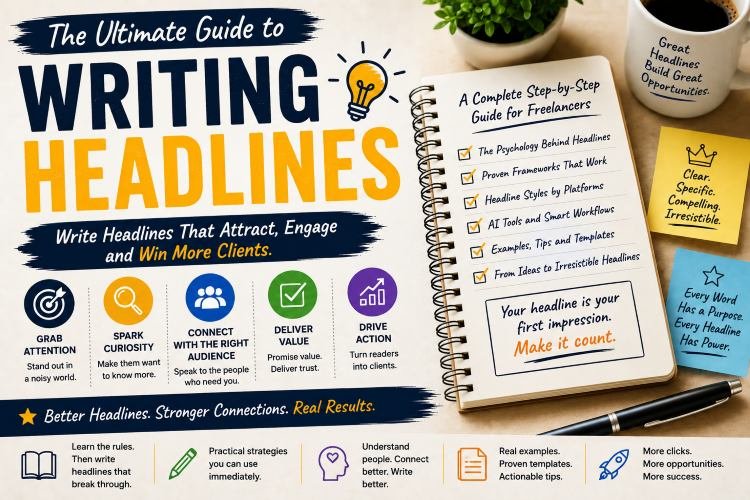
By the end, you’ll know how to write better headlines for:
- Your portfolio website
- LinkedIn posts
- Freelance proposals
- Email subject lines
- Blog articles
- Google Ads
- Facebook Ads
- Fiverr and Upwork profiles
- Course titles
- Landing pages
- Service pages
- Social media posts
More importantly, you’ll understand how to think like the person reading them. Because that’s where great headlines begin.
The Biggest Myth About Headlines
Many freelancers believe a headline exists to describe what’s below it. That’s only half true.
A headline has one primary job:
To earn the next few seconds of the reader’s attention.
Not to close the sale. Not to explain everything. Not to prove your expertise.
Just to convince the reader that what’s next is worth their time.
Think of a movie trailer: It doesn’t tell you the entire story. It gives you enough reason to buy a ticket.
A headline works the same way. If the headline fails, the rest of your content never gets a chance.
Two Freelancers. Same Skills. Different Results.
Let’s look at a simple example.
Freelancer A
Web Development Services
Technically correct. But would you click? Probably not.
Now look at Freelancer B.
Fast, Mobile-Friendly WordPress Websites That Turn Visitors Into Customers
Notice the difference. The second headline immediately answers questions a potential client is likely to have:
- What service is being offered?
- Who is it for?
- Why should I care?
- What outcome can I expect?
The second freelancer hasn’t changed their skills. They’ve simply changed how those skills are introduced.
Sometimes that’s enough to earn the conversation.
A Simple Exercise
Before reading further, visit your own: LinkedIn profile, Portfolio, Website, Freelance marketplace profile, Blog homepage
Now ask yourself one question:
Would this headline make me stop if I knew nothing about myself?
Be honest. If the answer is “probably not,” don’t worry.
You’re not alone. And by the time you finish this guide, you’ll have the tools to change that.
The Journey Ahead
Over the next Post, we’ll explore:
- Why the human brain notices certain headlines and ignores others.
- The psychology of attention and curiosity.
- Why do some headlines earn trust while others feel like clickbait?
- Proven headline structures used by marketers and copywriters.
- Real examples from freelancing, consulting, and digital services.
- A practical workflow you can use every time you need to write a headline.
Because learning to write better headlines isn’t about becoming a copywriter.
It’s about making sure the value you already provide gets the attention it deserves.
So, are you ready to go deep? Click YES if you wish to continue reading.
You can reach me on LinkedIn, too.