
Let’s address the elephant in the room. Today, as a writer, you can ask an AI tool for anything.
Today, you can ask an AI tool: “Give me 50 headlines for a blog post about freelancing.”
In a few seconds, you’ll have more ideas than most people could write in an afternoon.
That’s impressive. It’s also misleading. Because generating headlines and writing great headlines are two very different things.
AI has dramatically lowered the cost of creating words. It hasn’t eliminated the need for judgment. And judgment is where freelancers still create value.
AI Is Fast. Humans Decide What Matters.
Imagine asking five experienced chefs to cook the same meal. Now imagine asking five beginners to cook it. Everyone has access to the same ingredients. The difference isn’t the ingredients. It’s the decisions.
AI gives everyone access to the ingredients. But someone still has to decide;
- Which idea is worth pursuing?
- Which headline feels authentic?
- Which promise can actually be delivered?
- Which message speaks to this audience?
- Which headline reflects my personal brand?
Those decisions belong to you. Not the AI.
AI Is an Incredible Headline Brainstorming Partner
One of the best ways to use AI isn’t to ask for the headline. It’s to ask for possibilities.
Instead of saying: Write my headline.
Try asking: Give me 30 different approaches to introducing this topic.
Now you have options. Some may be weak. Some may be repetitive. One or two may spark an entirely new direction you hadn’t considered. That’s where AI shines. It expands the conversation. It doesn’t finish it.
The First Draft Is Rarely the Final Draft
One mistake I see many people make is accepting the very first AI suggestion. Imagine hiring a graphic designer.
Would you expect the first sketch to become the final logo? Probably not.
The same should apply to AI-generated headlines. Treat them as rough sketches.
For example, AI might suggest: 10 Tips for Freelancers
- Useful? Maybe.
- Memorable? Not really.
Now start asking questions.
- Can it be more specific?
- Can it create curiosity?
- Can it focus on an outcome?
- Can it speak to beginners?
- Can it challenge an assumption?
- Can it sound more human?
After a few rounds of refinement, the headline becomes something entirely different. Not because AI became smarter. Because you became the editor.
Don’t Ask AI for Answers. Ask It Better Questions.
The quality of AI’s output often depends on the quality of your prompt.
Instead of asking: Give me headlines.
Try asking:
- Which headline would appeal to a freelancer with less than one year of experience?
- Rewrite these headlines without using clickbait.
- Which headline sounds the most trustworthy?
- Which headline would perform better on LinkedIn than on Google?
- Which one feels too generic?
- How can I make this benefit more obvious?
Notice the difference. You’re no longer asking AI to think for you.
You’re asking it to think with you. That’s a much more powerful partnership.
AI Doesn’t Know Your Story
One thing AI can never fully understand is your personal journey.
It doesn’t know:
- The proposal that changed your career,
- The client who taught you a difficult lesson,
- The mistake you never want to repeat,
- The project that made you rethink your process,
- Or the moment you almost gave up freelancing.
Those experiences belong to you. And they often become your strongest headlines. Compare these two titles.
How to Manage Difficult Clients
Now compare it with:
The Client Who Nearly Made Me Quit Freelancing—and What They Taught Me
The second headline has something AI can’t invent.
Experience: Readers connect with authenticity because they recognize that it comes from lived experience, not just assembled information.
AI Can Recognize Patterns. You Recognize People.
AI is excellent at identifying language patterns.
It can tell you:
- Which words appear frequently?
- What structures are common?
- What styles are popular?
But writing isn’t only about patterns. It’s about people. Imagine receiving two proposals.
One is technically perfect. The other feels like the freelancer genuinely understands your business.
Which one would you reply to? Most people choose the second. Not because it’s flawless. Because it feels human.
That’s your competitive advantage.
Don’t Chase AI. Develop Your Taste.
One of my favorite ideas comes from the creative world. As tools become more accessible, taste becomes more valuable. Everyone can generate 100 headlines.
Not everyone can recognize which one deserves to be published. That’s a skill. And like every skill, it improves with practice. Read headlines every day. Save the ones that make you stop.
Ask yourself: Why did this one catch my attention?
Over time, your instincts become stronger. Eventually, you’ll start editing AI rather than relying on it. That’s where you want to be.
My Personal AI Workflow
People often ask me: “How do you use AI when writing?”
Here’s the process I follow.
Step 1 – Start with the reader
Before opening AI, I ask: Who am I helping? What problem are they trying to solve?
Step 2 — Brainstorm widely
I ask AI for many different angles. Not one perfect headline. Twenty or thirty possibilities.
Step 3 — Remove the obvious ones
Most first ideas are predictable. I deliberately eliminate the generic options.
Step 4 — Rewrite
I combine ideas. Change wording. Add specificity. Simplify. Improve the benefit.
Step 5 — Let it rest
If possible, I walk away for a while. When I return, the stronger headline often becomes obvious. Distance improves judgment.
Step 6 — Read it aloud
This is my final test. If the headline sounds unnatural when spoken, it probably reads unnaturally too. Simple language usually survives the read-aloud test.
The Future Belongs to Freelancers Who Combine AI With Judgment
There was a time when using a calculator didn’t make someone less intelligent. It allowed them to spend more time solving meaningful problems.
AI is similar. It removes much of the repetitive work.
That creates space for something more valuable: Thinking. Empathy. Creativity. Experience. Judgment.
Those qualities don’t become less important because of AI. They become more important.
A Practical Exercise
Open your favorite AI tool. Ask it to generate twenty headlines for your next article. Now don’t choose one.
Instead, ask yourself:
- Which headline feels most useful?
- Which feels most honest?
- Which sounds like something I would genuinely say?
- Which one promises value without exaggeration?
- Which one would I personally click?
If none of them feel right, don’t publish them. Improve them. That’s your role.
Key Takeaways
AI has changed headline writing forever. But it hasn’t removed the need for thoughtful writers.
Remember:
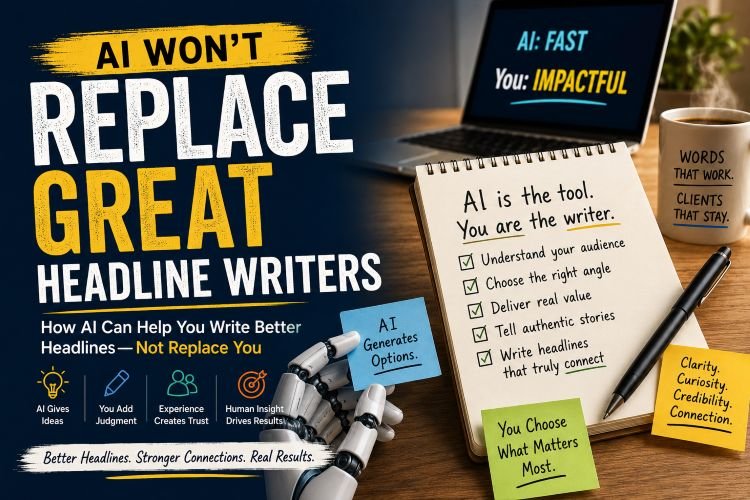
- AI generates options.
- You make decisions.
- AI accelerates brainstorming.
- You provide experience.
- AI recognizes patterns.
- You understand people.
- AI writes quickly.
- You decide what deserves to be read.
The future doesn’t belong to freelancers who resist AI. It also doesn’t belong to freelancers who blindly accept everything AI produces. It belongs to those who learn to collaborate with it.
A Closing Reflection
Earlier in this guide, I wrote that great headlines begin with empathy. After everything we’ve explored, I believe that’s even more true.
- AI can suggest words.
- It can imitate styles.
- It can organize information.
But it cannot genuinely care about whether a freelancer wins their first client, rebuilds their confidence after rejection, or finally earns enough to leave a job they no longer enjoy. But you can.
And when your writing comes from that place – not from a desire to impress, but from a desire to help – it becomes difficult to replace.
Technology will continue to evolve. New AI models will arrive. Headline generators will become faster and smarter.
But as long as people choose to work with people, empathy, honesty, and lived experience will remain your greatest competitive advantages. So don’t try to compete with AI.
- Learn from it.
- Challenge it.
- Edit it.
- Collaborate with it.
Then add the one ingredient no machine can fully replicate: You.
Up Next: Part 8 – From Blank Page to Brilliant Headline: A Step-by-Step Workflow
We’ve learned the psychology, the building blocks, the frameworks, where ideas come from, how different platforms work, and how AI fits into the process.
Now it’s time to bring everything together into a practical workflow – a repeatable process you can use every time you need to write a headline.
My goal is that after reading the next post, you’ll never again stare at a blank page wondering where to begin.