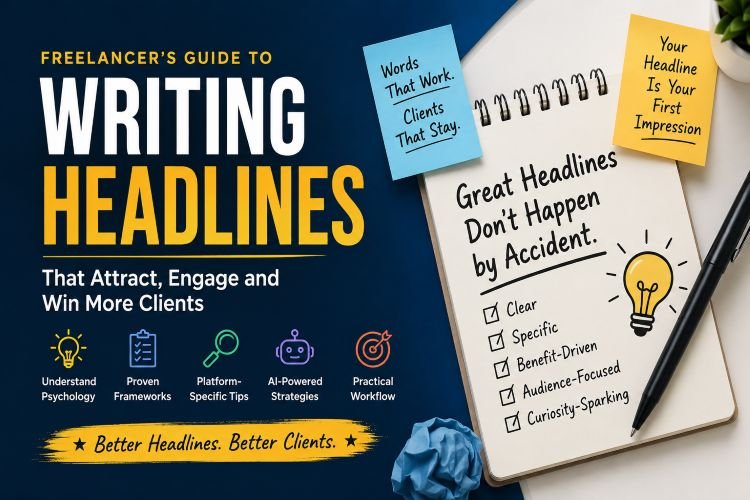
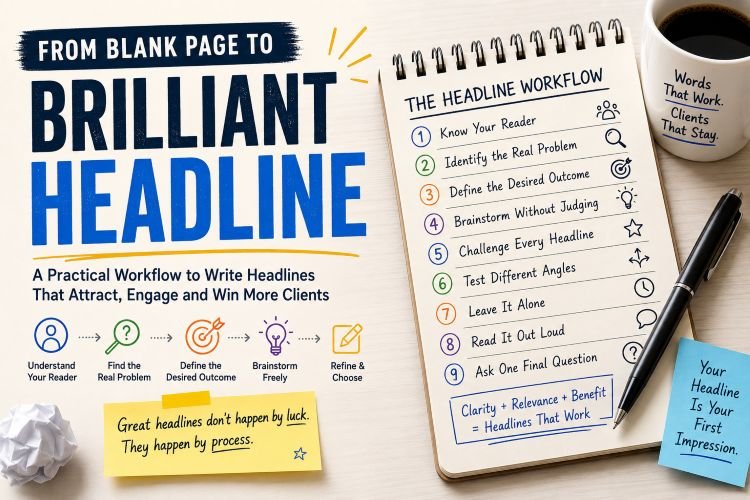
If you have read all the related prior posts of this Headline Writing guide, you might be wondering:
“This all makes sense… but where do I actually begin?”
That’s a fair question. When you’re staring at a blank page, it’s easy to overthink every word.
Ironically, many freelancers don’t struggle because they can’t write. They struggle because they try to write the headline first. Here’s a secret that may surprise you.
Professional writers rarely begin with the final headline.
They begin with understanding. The headline comes later.
Over the years, I’ve found myself following the same process again and again. Sometimes consciously, sometimes without even realizing it.
Today, I’d like to share that process with you. It’s simple enough to use every day, yet powerful enough to improve almost every piece of content you create.
Step 1 — Know Who You’re Writing For
Before you write a single word, answer this question: Who is this for?
Not everyone. One person. Imagine you’re writing to a freelancer who has just landed their first client.
Your headline will sound very different than if you’re writing to someone running a successful agency.
For example:
Beginner: How to Find Your First Freelance Client?
Experienced Freelancer: How to Increase Client Retention Without Lowering Your Rates?
Same profession. Different audience. Different headline.
The more clearly you picture your reader, the easier every decision becomes.
Step 2 – Identify the Real Problem
People don’t consume content because they enjoy collecting information. They consume content because they want to make progress.
Ask yourself:
- What is frustrating my reader today?
- What obstacle are they facing?
- What question keeps appearing in conversations?
If your article solves one meaningful problem, you’ve already created value.
Step 3 – Define the Desired Outcome
Every problem points toward an outcome. For example:
| Problem | Desired Outcome |
|---|---|
| No freelance clients | Get the first client |
| Poor proposal responses | More replies |
| Low website traffic | More visitors |
| Weak portfolio | More enquiries |
| Poor LinkedIn engagement | More conversations |
Notice something. Your headline should point toward the outcome – not dwell only on the problem. People are attracted to hope.
Step 4 – Brainstorm Without Judging
Now comes the fun part.
Write A lot. Don’t aim for one perfect headline. Aim for twenty. Or thirty. Or fifty.
Most of them will be average. That’s perfectly normal. The first few ideas usually come from memory.
The interesting ones appear after you’ve exhausted the obvious. Give yourself permission to write bad headlines.
They’re often stepping stones to better ones.
Step 5 – Challenge Every Headline
Now become your own editor. For each headline, ask:
- Is it clear?
- Is it specific?
- Is there an obvious benefit?
- Would I stop scrolling?
- Does it sound believable?
- Could I remove unnecessary words?
- Does it speak to the reader instead of me?
If the answer is “no,” rewrite it. Good writing isn’t created by getting it right the first time. It’s created by repeatedly improving it.
Step 6 – Test Different Angles
Let’s imagine your topic is: Freelance Pricing. Now, explore different approaches.
Educational: How to Price Your Freelance Services With Confidence
Curiosity: Why Most Freelancers Charge Too Little
Story: The Pricing Mistake That Cost Me My Best Client
Checklist: A Freelancer’s Pricing Checklist Before Sending a Proposal
Comparison: Hourly Rates vs Project Pricing: Which Makes More Sense?
Same topic. Five different doors into the conversation. One of them will usually feel stronger than the others.
Step 7 – Leave It Alone
This step surprises people.
- Walk away.
- Seriously.
- Go make coffee.
- Take a walk.
- Answer a few emails.
When you return, you’ll often notice things you completely missed before.
Distance improves judgment. Many of my favorite headlines weren’t written. They were rewritten.
Step 8 – Read It Out Loud
This is one of the simplest editing techniques I know. Read your headline aloud. If it feels awkward to say, it will probably feel awkward to read.
Natural language usually sounds natural. Complicated language usually sounds complicated. Your ears often catch what your eyes overlook.
Step 9 – Ask One Final Question
Before publishing, ask yourself: “If I knew nothing about this topic, would I click?”
Not because you’re proud of writing it. Not because you spent hours on it.
Simply because it genuinely seems useful. That’s the only opinion that matters.
Let’s Walk Through a Real Example
Suppose you want to write about building a freelance portfolio.
Here’s how the workflow unfolds.
Audience: New freelancers.
Problem: “I don’t have enough work to build a portfolio.”
Desired Outcome: Create a portfolio that attracts clients.
Brainstorm:
- Portfolio Tips
- Freelance Portfolio Guide
- How to Build a Portfolio Without Clients
- Why Your Portfolio Isn’t Getting Attention
- Five Portfolio Mistakes Beginners Make
- Build a Portfolio That Wins Better Clients
After reviewing them, you might choose:
How to Build a Freelance Portfolio That Wins Better Clients—Even If You Don’t Have Much Experience
Notice that this final version didn’t appear instantly. It evolved. That’s exactly how good headlines are created.
Your Personal Headline Checklist
Before publishing anything, quickly review this list.
- ✅ Is it clear?
- ✅ Does it solve a real problem?
- ✅ Is there an obvious benefit?
- ✅ Is it written for a specific audience?
- ✅ Does it sound natural?
- ✅ Is it believable?
- ✅ Would I click it?
If you can confidently answer “yes” to most of these questions, you’re ready to publish. Don’t chase perfection. Chase usefulness.
One Last Piece of Advice
Earlier in this series of articles, we explored Psychology, Frameworks, AI, Platform-specific writing, Exercises, and Examples.
But after all of that, I don’t want you to leave believing that great headlines are built from formulas.
They’re built from empathy. Every headline is a promise.
A promise that if someone gives you a few minutes of their attention, you’ll make those minutes worthwhile.
Honor that promise consistently, and something interesting begins to happen.
People start trusting your writing. And once people trust your writing, they’re far more likely to trust your work.
My Personal Experience – Whether you’re a designer, developer, consultant, writer, marketer, or project manager, that trust becomes one of the most valuable assets you’ll ever build.
So What Are The Key Takeaways
Before you write your next headline, remember this workflow:
- Know your reader.
- Understand their problem.
- Focus on the outcome.
- Brainstorm freely.
- Edit relentlessly.
- Explore multiple angles.
- Step away.
- Read it aloud.
- Publish with confidence.
Simple. Repeatable. Practical. > Remember: Your Headline is more than a Title