Why is it important to know your buyer and visitor intent when buying traffic? In this article, I will discuss how visitor intent determines the primary course of your digital campaign.
Table of Contents
Why Most Freshers Get This Wrong (And Why It Matters)
Why is it important to know your buyer and visitor intent when buying traffic? When you’re starting out in media buying, the numbers pull you in first. You see a keyword with 10,000 monthly searches at $0.50 CPC, and your brain does the math: “If I can get even 2% of that traffic…” You start building campaigns around volume and cost metrics, optimizing for clicks, watching your CTR like it’s the only thing that matters.
Here’s what nobody tells you in those first few weeks: you’re optimizing for the wrong thing.
I’ve seen media buyers burn through five-figure budgets chasing high-volume keywords that converted at less than 0.1%. I’ve watched campaigns get pulled because the traffic “looked good on paper”, but produced nothing but bounce rates and angry account managers. The problem wasn’t the traffic source. It wasn’t even the landing page, necessarily. The problem was an intent mismatch.
Not all clicks have the same value. Some clicks are worth $50 in eventual revenue. Others are worth exactly nothing, and worse, they waste your time analyzing why they didn’t convert when the answer was obvious from the start: they were never going to.
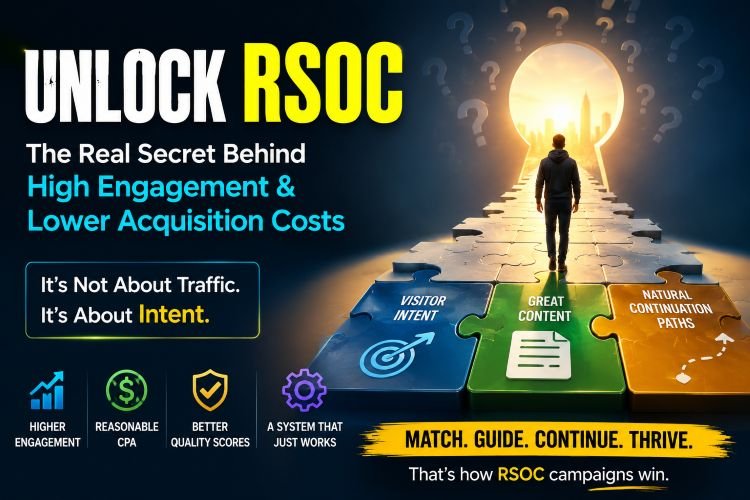
In RSOC campaigns specifically, understanding visitor intent isn’t just helpful – it’s the entire foundation of whether your campaign lives or dies. And most freshers don’t even know what visitor intent really means beyond the textbook definition they skimmed once.
This article is going to change that.
What Visitor Intent Actually Means (Beyond the Textbook)
Visitor intent is the “why” behind the search. It’s the psychological state, the emotional driver, the actual goal that made someone type those specific words into a search box.
But let’s get more practical. Intent is the answer to these questions:
- What problem does this person have right now?
- What do they expect to find when they click?
- How close are they to making a decision?
- What will make them satisfied enough to keep exploring?
- Are they browsing, learning, comparing, or ready to buy?
A keyword isn’t just a string of words. It’s a snapshot of someone’s mental state at a specific moment. “Best running shoes” and “Nike Pegasus 40 size 10 buy now” both relate to running shoes, but they represent different people at different stages of their journey.
The first person is exploring. They might not even know what brand they want. They’re early, curious, probably going to read reviews and watch videos, maybe visit 10 different sites before they even think about pulling out a credit card.
The second person? They know exactly what they want. They’ve done their research. They’re ready. They just need a place to complete the transaction.
Same product category. Completely different intent. Completely different monetization approach. Completely different suitability for RSOC.
This is what I mean when I say intent is psychological, not just categorical.
How RSOC Works in Simple Human Terms
Before we dive deeper into intent types, let’s make sure we understand how RSOC actually functions from the user’s perspective.
The journey looks like this:
- User searches something → let’s say “why is my laptop overheating.”
- They click a search ad → because the headline spoke to their problem
- They land on an article → hopefully one that actually addresses laptop overheating
- They read (or skim) the content → looking for answers, solutions, or next steps
- They see related search suggestions → either from native widgets or RSOC placements
- They click one of those suggestions → because they want to explore further
This is the continuation behavior. This is where RSOC monetization happens.
But here’s the critical part most freshers miss: that continuation only happens if the first experience met their expectations and left them wanting more.
If your initial ad promised “Fix Laptop Overheating in 5 Minutes” but the landing page was generic fluff that didn’t actually help, they’re not clicking anything else. They’re leaving. They feel misled. The continuation dies.
If your ad matched their intent, the content delivered real value, and the related searches feel like natural next steps in their journey, they keep exploring. That’s when RSOC traffic becomes valuable.
User satisfaction isn’t a soft metric here. It’s the entire engine that drives whether RSOC works.
The Five Intent Types That Actually Matter in RSOC
Let me break down the main intent types in a way that’s useful for actual campaign work, not academic classification.
1. Curiosity Intent (Informational, Early Stage)
Visitor Mindset:
“I just heard about this. What is it? I’m not here to buy anything, I’m just browsing.”
Examples:
- “what is keto diet”
- “who invented blockchain”
- “why do cats purr”
- “what causes northern lights”
Monetization Potential:
Low to moderate. These visitors are far from any purchase decision. But if you educate them well, you can guide them deeper.
RSOC Suitability:
Actually pretty good, because curious people click around. They explore. They follow rabbit holes. The key is having content that satisfies their curiosity while naturally suggesting deeper topics.
Risks if Mismatched:
If you try to hard-sell someone in curiosity mode, they bounce immediately. If your content feels like a sales pitch disguised as information, trust drops to zero. These visitors want to learn, not be sold to.
What Works Here:
Genuine educational content that acknowledges they’re early in their journey. Natural progression to related questions. Building trust through expertise, not urgency.
2. Problem-Aware Intent (Recognizing the Issue)
Visitor Mindset:
“I have a problem. I’m not sure what’s causing it or how to fix it, but I know something is wrong.”
Examples:
- “why am I always tired”
- “laptop running slow”
- “lower back pain when sitting”
- “houseplants turning yellow”
Monetization Potential:
Moderate. They’re not ready to buy yet, but they’re motivated because they have a real problem. If you can help them understand the cause, you become trusted, and they’ll keep listening.
RSOC Suitability:
Excellent. Problem-aware searches are gold for RSOC because these people are actively seeking understanding. Once they understand their problem better, they naturally want to know about solutions. That continuation behavior is exactly what RSOC needs.
Risks if Mismatched:
If you jump straight to selling a solution before helping them understand their problem, you lose credibility. They’re not ready for “Buy This Product Now” – they’re ready for “Here’s Why This Is Happening.”
What Works Here:
Diagnostic content. Explaining causes. Creating that “aha” moment where they finally understand what’s going on. Then, naturally, bridging to “Now that you know what’s causing it, here’s what people typically do about it.”
3. Solution-Seeking Intent (Exploring Options)
Visitor Mindset:
“I know what my problem is. Now I need to figure out how to solve it. What are my options?”
Examples:
- “how to fix a leaky faucet”
- “best ways to lose belly fat”
- “treatments for anxiety”
- “how to learn Python programming”
Monetization Potential:
High. These people are ready to take action. They just need direction. If you can present yourself as the guide who helps them choose the right path, conversion potential is strong.
RSOC Suitability:
The sweet spot for RSOC. These visitors are in exploration mode but with a purpose. They’ll read multiple articles, compare approaches, and click through to related topics about specific solutions. They’re active learners with motivation.
Risks if Mismatched:
If your solution is too general or doesn’t actually address their specific problem type, they’ll keep searching elsewhere. If you oversimplify or make unrealistic promises, they’ll distrust everything else you say.
What Works Here:
Comprehensive guides that compare different approaches honestly. Pros and cons. Realistic expectations. Helping them narrow down what’s right for their situation. Then offering specific next steps that feel like a natural progression.
4. Commercial Investigation Intent (Comparing Before Buying)
Visitor Mindset:
“I’m probably going to buy something soon. I just need to make sure I’m making the right choice. Show me comparisons, reviews, and why one option is better than another.”
Examples:
- “Shopify vs WooCommerce”
- “best noise cancelling headphones under $200”
- “Grammarly review 2024”
- “NordVPN vs ExpressVPN”
Monetization Potential:
Very high. These people have budgets and timelines. They’re in decision mode. If you help them decide, and your recommendation includes an affiliate link or direct offer, conversion rates can be excellent.
RSOC Suitability:
Good, but tricky. The challenge with commercial investigation traffic in RSOC is that these people are often close to making a decision. They might not want to explore ten more articles; they want to make their choice and move on. Your continuation behavior depends on whether your content leaves questions unanswered or introduces new angles they hadn’t considered.
Risks if Mismatched:
If your comparison is clearly biased or reads like an affiliate-driven sales page, they’ll dismiss it. If you’re pushing them toward a product that doesn’t fit their stated needs, they’ll bounce. These visitors are sophisticated and can smell BS.
What Works Here:
Genuinely helpful comparisons. Addressing real concerns. Being honest about trade-offs. Respecting their intelligence. If your recommendation is solid and they trust your analysis, they’ll convert through your link. If not, they’ll go find someone else’s opinion.
5. Immediate Transaction Intent (Ready to Buy Now)
Visitor Mindset:
“I know exactly what I want. I just need to find it, check the price, and buy it. Don’t waste my time with fluff.”
Examples:
- “buy iPhone 15 Pro Max 256GB”
- “Nike Air Max 270 black size 9”
- “Semrush pricing”
- “book flight to Bali”
Monetization Potential:
Extremely high per conversion, but lower volume in most niches. These are bottom-of-funnel searches. If you can capture them, they convert immediately.
RSOC Suitability:
Actually quite poor for traditional RSOC. Why? Because these people don’t want to read articles or explore related content. They want a shopping cart. They want a buy button. Sending them to content pages frustrates them. They’re not going to engage with related search suggestions. They’re going to bounce and find a direct purchase path.
Risks if Mismatched:
Huge. If someone types “buy X product now” and you send them to an article about “The Ultimate Guide to X Products,” they’re gone. You’ve wasted a high-intent click on a format that doesn’t serve their need. This is one of the most common and expensive mistakes in RSOC.
What Works Here:
Not RSOC. Direct e-commerce. Shopping ads. Product pages with clear CTAs. These searches belong in different campaign types entirely.
The Golden RSOC Intent Zone (Where the Magic Happens)
After running enough campaigns, you start to notice a pattern. The traffic that performs best in RSOC isn’t at the extreme ends of the intent spectrum.
It’s not pure curiosity browsing – those clicks are too early, too scattered.
It’s not immediate transaction intent – those clicks don’t want content, they want checkout pages.
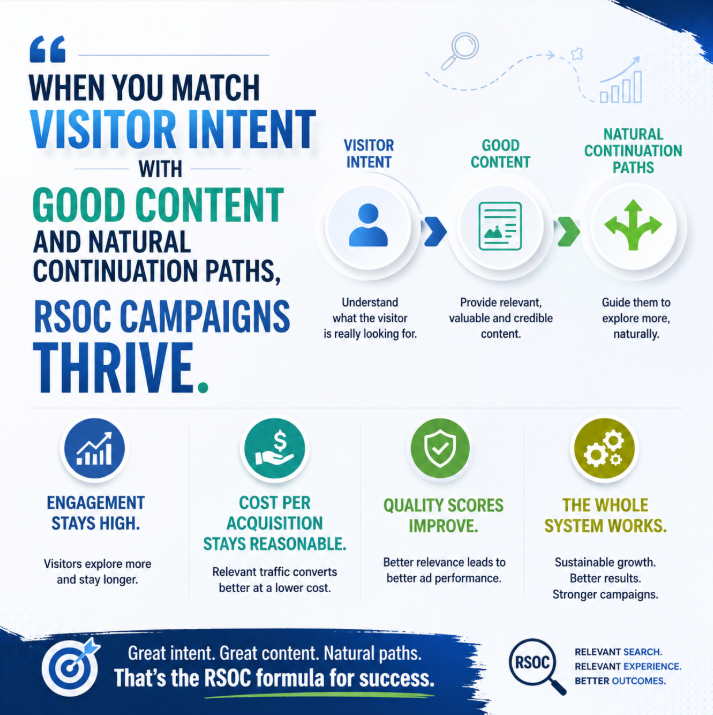
The sweet spot is Problem-Aware, Solution-Seeking, and early Commercial Investigation intent.
Why? Because these visitors are:
- Motivated (they have a real need)
- Exploratory (they’re willing to read and learn)
- Open to guidance (they haven’t made final decisions yet)
- Likely to continue (their journey isn’t finished)
This is what I call mid-funnel traffic with momentum. They’re not window shopping, but they’re not ready to pull the trigger yet either. They’re in that active learning phase where high-quality content actually influences their decisions.
When you match this intent with good content and natural continuation paths, RSOC campaigns thrive. Engagement stays high. Cost per acquisition stays reasonable. Quality scores improve. The whole system works.
Most freshers either chase the top of the funnel (too broad, too early) or try to force bottom-of-funnel traffic through content experiences (immediate frustration, instant bounce). Learning to identify and target that middle zone is where you start seeing consistent performance.
Expectation Match: The Make-or-Break Moment
Here’s a framework I wish someone had taught me earlier: Expectation Match.
Every click carries an expectation. The searcher clicked your ad because the headline promised something. They have a mental picture of what they’re about to see. Your job is to match that expectation so perfectly that they trust you immediately.
Let me show you what I mean with examples.
Good Expectation Match
Search Query: “how to remove coffee stains from carpet.”
Ad Headline: “Remove Coffee Stains from Carpet: 3 Methods That Actually Work”
Landing Page: Article with clear instructions, photos showing the process, realistic time expectations, supplies needed, tips for different carpet types.
Result: User finds exactly what they expected. Problem solved. Trust established. When they see related searches like “best carpet cleaning products” or “how to prevent carpet stains,” they click because you’ve proven you’re reliable.
TIP: Search Keyword Planners not only with filters by numbers, but most importantly by Intent.
Bad Expectation Match #1 (Bait and Switch)
Search Query: “how to remove coffee stains from carpet.”
Ad Headline: “The Secret to Stain-Free Carpets (Professional Trick)”
Landing Page: Generic article about carpet care that barely mentions coffee stains, with most of the content pushing a carpet cleaning service or product.
Result: User feels tricked. They wanted a DIY solution, not a sales pitch. They bounce. They don’t trust anything else you show them. RSOC continuation dies immediately.
Bad Expectation Match #2 (Overcomplication)
Search Query: “how to fix a slow laptop.”
Ad Headline: “Fix Your Slow Laptop in 10 Minutes”
Landing Page: Dense technical article full of registry edits, command line instructions, and warnings about system files.
Result: The user expected simple, accessible solutions. What they got was complexity that makes them nervous. They leave to find something easier. The intent was right, but the execution didn’t match the implicit skill level they expected from a “10 minutes” promise.
Bad Expectation Match #3 (Undershooting)
Search Query: “advanced Google Ads bidding strategies for e-commerce.”
Ad Headline: “Master Google Ads for E-commerce”
Landing Page: Basic beginner guide explaining what Google Ads is and why you should use it.
Result: This searcher is past beginner content. They’re looking for advanced tactics. You’ve wasted their time with information they already know. They’ll remember your site as not worth visiting.
The lesson: The ad sets the promise. The landing page must deliver that promise at the right level, in the right format, with the right depth.
When the expectation match is tight, everything else becomes easier. Engagement goes up. Bounce rate goes down. Related searches are clicked because visitors trust that your suggestions will also be relevant.
Search Psychology: Reading Emotional States Through Keywords
One of the most valuable skills you can develop is reading the emotional state behind a search query. Keywords aren’t just topics—they’re emotional signals.
Let me show you what I mean:
| Keyword | Surface Topic | Emotional State | What They Really Want |
|---|---|---|---|
| “what is anxiety” | Mental health definition | Confusion, early concern | Understanding if what they’re feeling is normal |
| “how to stop anxiety attacks” | Anxiety management | Fear, urgency | Immediate relief techniques |
| “best therapist for anxiety near me” | Mental health services | Ready for help, vulnerable | Someone who understands and can help |
| “is anxiety medication safe” | Medication concerns | Fear, hesitation | Reassurance about a decision they’re considering |
Same broad topic. Four completely different emotional states. Four different content needs. Four different monetization approaches.
Or look at this progression:
- “losing weight” → Vague desire, no real plan yet
- “how to lose 20 pounds” → Specific goal forming
- “how to lose 20 pounds in 3 months” → Goal + timeline = commitment
- “meal plan to lose 20 pounds” → Ready for structure and guidance
- “best weight loss program” → Ready to invest in a solution
You can feel the intent deepening as the queries get more specific. The emotional state moves from “I should probably do something” to “I’m ready to commit to a structured approach.”
When you understand this progression, you know where your content should sit. You know what questions to answer. You know what the natural next step is.
A fresher looks at these queries and sees keywords to bid on. An experienced media buyer sees a journey map of someone moving toward a decision, and plans content that meets them at exactly the right step.
Intent Depth: Why More Specific Usually Means More Valuable
Let’s talk about something called intent depth. It’s not a standard industry term, but it’s a useful way to think about search quality.
Shallow intent = broad, early-stage, lots of different possible paths
Deep intent = specific, focused, fewer but clearer possible actions
Examples:
Shallow: “home workout”
Could mean: looking for ideas, wanting free YouTube videos, considering equipment, just curious, might not even start
Deeper: “30-day home workout plan no equipment”
Means: committed to starting, has constraints (no equipment), wants structure, timeline indicates they’re serious
Even Deeper: “30-day bodyweight workout plan PDF beginner”
Means: ready to start now, wants something they can save and follow, knows their level, probably going to start this week
The deeper the intent, the more specific the query, the more valuable the click (usually). Why? Because specificity indicates decision-making progress. Vague searches are still in exploration mode. Specific searches are people who’ve already done some exploring and are ready for actionable answers.
This is why long-tail keywords often outperform head terms in RSOC, even though they have lower search volume. The depth of intent compensates for the volume difference.
A thousand clicks from “workout tips” might generate less meaningful engagement than a hundred clicks from “beginner strength training program for women over 40.” The second group knows exactly what they want. Your job is just to provide it.
Common Mistakes Freshers Make (And How to Avoid Them)
Mistake #1: Chasing Volume Over Quality
You see a keyword with 50K monthly searches and start planning how you’ll scale it. But when you look at the intent, it’s completely wrong for your offer. You launch anyway because “the volume is there.”
Reality check: High-volume searches are often high-volume because they’re too broad to convert well. “Lose weight” has high search volume but poor intent clarity. “Science-based fat loss for mesomorphs” has tiny volume but laser-focused intent.
Volume is ego metrics. Conversion rate is an income metric. Choose wisely.
Mistake #2: Using Misleading Ad Copy to Boost CTR
You know your content is basic, but you write headlines like “The Secret Method Doctors Don’t Want You to Know” or “One Weird Trick” because you’ve seen it work elsewhere.
Reality check: Yes, your CTR might spike. But your bounce rate will destroy you. Quality scores will tank. You’ll pay more per click while getting worse results. And if you’re running RSOC, continuation behavior will be nonexistent because you started the relationship with deception.
Clickbait kills RSOC campaigns slowly and expensively.
Mistake #3: Ignoring Landing Page Relevance
You have one generic landing page, and you’re sending twenty different intent types to it. “It’s related to the topic, so it should work,” you think.
Reality check: If someone searches “vegan meal prep for beginners” and lands on a page about general healthy eating, they’re not getting what they wanted. Even if healthy eating includes vegan options, the specificity mismatch creates immediate disappointment.
Every major intent shift needs its own landing page experience. Period.
Mistake #4: Misunderstanding Urgency
You target problem-aware searches with time-sensitive language: “Fix Your Laptop Overheating NOW!” But the visitor isn’t in panic mode – they’re in learning mode.
Reality check: Artificial urgency feels manipulative when the emotional state doesn’t match. If someone is casually researching something, “Act Now!” language creates friction, not motivation. Match your urgency signals to their actual emotional state.
Mistake #5: Assuming High CPC = Profitable
You see a keyword at $5 CPC and think, “That must convert well, or why would people pay that much?”
Reality check: High CPC often means high competition, not high conversion. Sometimes it means advertisers haven’t realized the keyword is actually terrible. Sometimes it means the keyword is good for one specific business model but terrible for yours.
Never let CPC be your primary signal for intent quality. Analyze the intent first, then decide if the economics work.
Practical Training Exercise: Build Your Intent Classification Skills
Here’s what I recommend to every fresher who wants to get good at this:
Exercise: The Intent Classification Audit
Step 1: Take 50 keywords from your niche or industry.
Step 2: For each keyword, write down:
- What expectation does this search create?
(What does the searcher expect to see when they click?) - What emotional state is this person in?
(Curious? Frustrated? Ready to buy? Confused?) - What would satisfy this search?
(Article? Product page? Tool? Video? Comparison?) - Would they continue exploring after landing?
(Is this a one-and-done search, or are they on a journey?) - Is this suitable for RSOC?
(Does the format and intent match content-based continuation behavior?)
Step 3: Group your keywords by intent type.
Step 4: Review your current campaigns and identify where the mismatches are.
You’ll be shocked at how many keywords you’re bidding on that never had a chance of working in RSOC. You’ll also find hidden gems you’ve been ignoring because they didn’t have massive volume.
Bonus Exercise: Reverse Engineering
Pick five competitors who are clearly profitable in your niche (you can tell by how long they’ve been running ads consistently). Look at what keywords they’re targeting. Analyze the landing pages they’re using. Try to reverse-engineer their intent strategy.
What intent types are they focusing on? How are their landing pages matched to search expectations? What continuation paths are they creating?
This teaches you faster than any course because you’re studying what actually works in the real marketplace, not what sounds good in theory.
My Advice: The Truth About RSOC Success
Let me leave you with something I wish I’d understood years earlier, long ago.
Success is not about getting clicks. It’s about getting meaningful continuation behavior.
You can buy all the traffic you want. You can optimize CTR until you’re hitting 10%. You can split-test headlines until your eyes cross. But if the visitor clicks through, finds nothing that meets their expectation, and bounces. You’ve built an expensive traffic machine that produces nothing.
The campaigns that work, the ones that scale, the ones that actually make money – they’re built on a foundation of intent understanding.
They target searches where:
- The emotional state matches the content format
- The expectation can be genuinely fulfilled
- The visitor wants to keep learning after the first answer
- The natural next question leads to monetization
This is why two media buyers can run the “same” campaign with the same keywords and same budget, and one succeeds while the other fails. The difference isn’t in the technical setup. But understanding why people search, what they search, and respecting that psychology enough to serve it properly.
Stop thinking in keywords. Start thinking in psychological states.
Stop optimizing for clicks. Start optimizing for the moment someone decides you’re worth trusting with the next click.
Stop treating intent as a category to check off. Start treating it as the actual human being behind the search, trying to solve a real problem, and your job is to be helpful enough that they let you guide them forward.
That’s when RSOC stops being a struggle and starts being a system that actually works. And that’s when you stop being a fresher who chases metrics and start being a media buyer who understands traffic.
Now go audit your campaigns. You’ll find problems you didn’t know existed. And that’s exactly how you get better.
If this article helped you think differently about intent and RSOC campaigns, you’re exactly the kind of marketer I write for. Connect with me: Rohit K. I would love to hear your views.
Do link and share this post, it will motivate me to share more practical media buying insights, campaign breakdowns, and the kind of stuff they don’t teach in courses.
Drop a comment or reach out if you have questions. Happy to help.