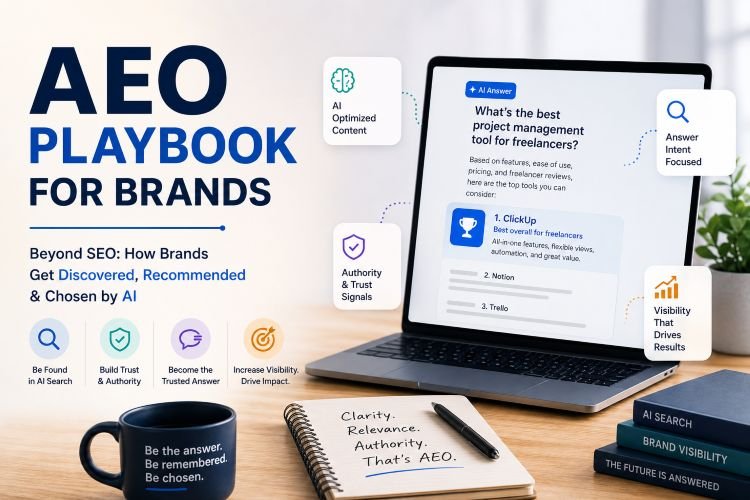
For nearly two decades, digital visibility was largely a ranking problem. If your brand ranked on page one of Google, you had a chance to earn attention, clicks, and customers.
That model is changing rapidly. But today, Search Is No Longer Just a List of Links.
Today, millions of users are increasingly interacting with AI systems like ChatGPT, Gemini, and Perplexity not as traditional search engines, but as decision-support systems capable of synthesizing information conversationally.
Instead of scanning ten blue links, users now ask questions such as “What’s the best CRM for small businesses?”, “Which project management software is easiest to implement?”, or “Compare HubSpot and Salesforce for startups.”
And increasingly, AI systems answer directly.
This shift is creating a new visibility challenge for brands. If your company is not mentioned, cited, retrieved, or otherwise understood by these systems, you may be excluded from important stages of the buyer journey.
This emerging discipline is often referred to as Answer Engine Optimization (AEO), which focuses on improving how AI systems discover, understand, retrieve, interpret, and reference your brand and content.
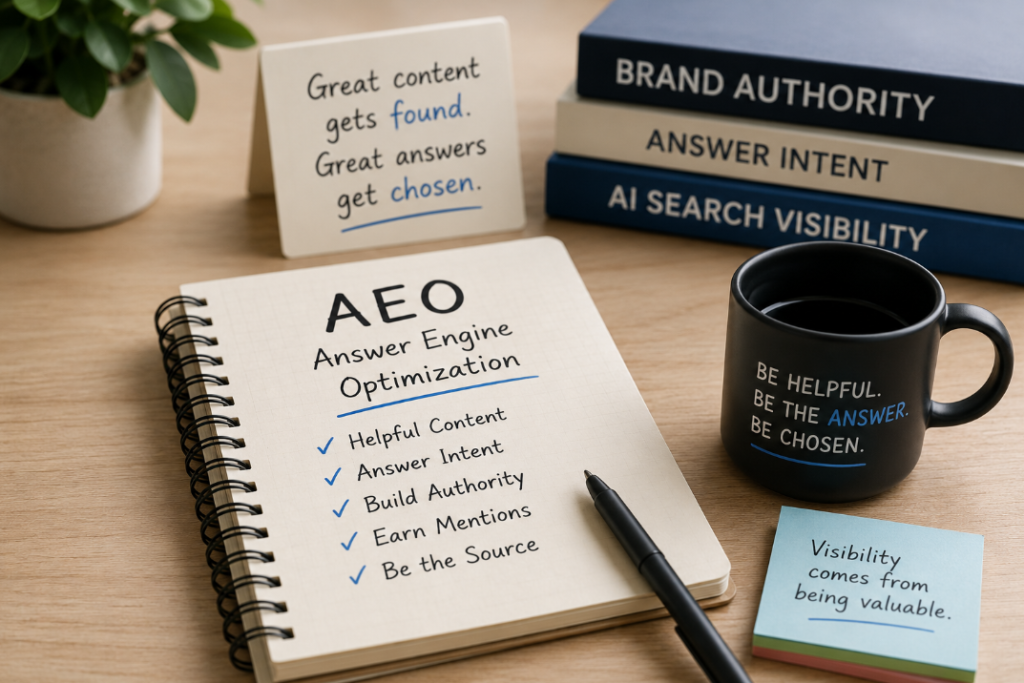
Unlike traditional SEO, AEO is not purely about rankings. It is increasingly connected to entity understanding, semantic retrieval, contextual authority, content structure, technical accessibility, and citation trustworthiness.
While the ecosystem is still evolving rapidly, clear behavioral patterns are beginning to emerge across answer engines.
Understanding the Rise of Answer Engines
Traditional search engines primarily retrieve and rank pages.
Modern AI systems operate differently. Many of them combine large language models with retrieval systems that can pull information from indexed sources, knowledge graphs, semantic embeddings, and structured content layers before generating synthesized responses.
Rather than relying only on keyword matching, these systems attempt to understand meaning, relationships, entities, context, and intent.
This fundamentally changes how visibility works.
In traditional search, users could manually compare multiple results. In AI-driven environments, systems increasingly summarize, filter, and narrow the information landscape for users.
That means the concentration of recommendations increases significantly.
When AI systems provide only a handful of brand mentions during discovery moments, visibility becomes increasingly competitive.
Brands, therefore, need to optimize not only for search rankings but also for retrievability, semantic clarity, citation likelihood, and contextual authority.
The Major Consumer AI Discovery Platforms
ChatGPT combines pretrained knowledge with optional live retrieval and browsing, depending on the model and user experience in use. It performs particularly well in conversational explanation, comparative reasoning, educational synthesis, and multi-turn discussions. OpenAI has publicly stated that ChatGPT now serves hundreds of millions of users globally. OpenAI Usage Report
Gemini is deeply integrated into Google’s broader search and knowledge ecosystem. It benefits from Google’s structured indexing systems, knowledge graphs, AI Overviews, and long-established web infrastructure. Google has repeatedly emphasized the importance of structured data, crawlability, and helpful content for AI-powered experiences. Google AI Features Documentation
Perplexity operates more like an AI-native research assistant. It places strong emphasis on citations, retrievable sources, freshness, and transparent referencing. Industry observations suggest that Perplexity often favors recently updated, clearly structured, and easily extractable content. Perplexity Citation Analysis
What Actually Influences AI Visibility?
One of the biggest misconceptions surrounding AEO is the assumption that traditional SEO rankings alone guarantee AI visibility.
Current evidence suggests otherwise.
While traditional SEO remains highly important, answer engines (AEO) appear to rely on additional signals connected to semantic retrieval, entity understanding, contextual relevance, and synthesis confidence.
Several recurring patterns are increasingly observable across AI systems.
Entity Clarity Matters More Than Keyword Density
AI systems increasingly organize information around entities rather than simple keywords.
An entity may represent a company, product, founder, technology, category, location, or concept.
Strong entities are typically clearly defined, consistently described, semantically connected, and corroborated across multiple trusted sources.
Google’s structured data documentation strongly reinforces the importance of understanding machine-readable entities. Google Structured Data Documentation
In practical terms, brands benefit from maintaining strong organizational schema, consistent descriptions across platforms, structured product relationships, verified business profiles, authoritative mentions, and semantic consistency across the web.
Weak entity clarity creates ambiguity, while strong entity clarity improves retrieval confidence.
AI Systems Prefer Extractable Content
Modern retrieval systems often retrieve information at the chunk level rather than at the page level.
This means AI systems may retrieve a paragraph, a definition, a table, a process explanation, or a standalone section rather than an entire webpage.
This is one reason structured, and clearly organized content performs more effectively in AI retrieval environments.
Industry analyses around AI citation behavior consistently indicate that concise answer-first formatting, semantic HTML structure, clear headings, contextual completeness, and logically separated content sections improve retrievability. Perplexity Retrieval Research
Structured Data Helps Machines Understand Context
Structured data does not guarantee AI visibility.
However, it helps machines better understand what your page represents, what your organization does, what products you offer, and how entities relate to one another.
Google explicitly recommends structured data for enhanced understanding across search and AI experiences. Google AI Search Guidance
Important schema implementations often include Organization, Product, FAQPage, Article, Breadcrumb, Review, and HowTo schema, depending on the content.
Freshness Matters – But Differently Across Platforms
Different answer engines appear to evaluate freshness differently.
Perplexity often prioritizes recently updated and actively maintained content, while evergreen authority content that is periodically refreshed can continue performing strongly across multiple systems.
Freshness is therefore not simply about publication dates. It also involves maintenance, contextual relevance, update signals, evolving examples, and content accuracy.
Third-Party Validation Is Extremely Important
AI systems appear to place significant weight on corroborated information.
Brands discussed externally across trusted sources tend to build stronger retrieval authority than those that rely only on self-published content.
Important external validation signals may include review platforms, industry publications, analyst mentions, expert roundups, Reddit discussions, podcasts, GitHub references, YouTube discussions, and broader public authority.
This aligns closely with broader academic discussions around citation trustworthiness and retrieval confidence in generative systems. Research on Verifiability in Generative Search
The Six Core Drivers of AEO
Based on current industry observations and evolving retrieval behavior, six major drivers consistently appear important for improving answer engine visibility.
Entity Optimization
Your brand increasingly needs to become machine-readable through structured schema, semantic consistency, clear categorization, product relationships, public business profiles, knowledge graph alignment, and strong entity reinforcement across the web.
Question-Answer Architecture
AI systems are heavily trained on instructional and question-answer relationships, which means content that answers directly, explains clearly, supports claims with examples, and progressively expands context tends to perform better in answer engines.
A common pattern observed across effective answer-oriented content is the use of concise, direct answers first, followed by deeper explanatory context.
Comparative Context
Users increasingly ask answer engines comparison-oriented questions such as “Which tool is better?” or “Compare X vs Y.”
Comparative discovery is becoming a central layer of AI-assisted decision-making.
Brands that participate honestly in comparison discussions often strengthen their contextual visibility by helping users understand positioning, fit, trade-offs, and ideal use cases rather than simply pushing promotional messaging.
Semantic Authority Clusters
Topical depth matters significantly.
A single isolated article rarely establishes meaningful authority.
Semantic authority is often strengthened through interconnected topic ecosystems that reinforce contextual understanding. Strong topical ecosystems commonly include pillar guides, tutorials, FAQs, glossaries, comparisons, implementation walkthroughs, and case studies that collectively help AI systems better understand subject expertise.
Technical Accessibility
AI systems cannot retrieve content effectively if they struggle to access or interpret it.
Common technical blockers often include poor crawlability, excessive JavaScript rendering, blocked bots, missing sitemaps, slow website performance, fragmented information architecture, and inaccessible content structures that reduce retrieval efficiency for both search engines and AI systems.
Google itself repeatedly emphasizes crawlability, technical clarity, and accessible content structures for AI-powered discovery systems. Google AI Visibility Guidance
Reputation and Citation Trust
Answer engines increasingly synthesize information from multiple external sources, which means brand reputation itself becomes part of retrieval confidence.
Strong trust signals often come from expert mentions, review consistency, author reputation, public citations, industry participation, and broader authority signals distributed across the web, while weak or inconsistent reputation signals may reduce retrieval confidence.
What Most Brands Still Get Wrong
One of the most common mistakes is treating AEO as simply “SEO renamed.”
While there is significant overlap between SEO and AEO, the two are not identical.
Traditional SEO primarily focuses on rankings, keywords, backlinks, indexing, and click-through optimization, whereas AEO increasingly focuses on retrieval quality, contextual understanding, semantic clarity, answer extraction, entity confidence, and citation probability.
Another common mistake is publishing large volumes of shallow AI-generated content.
Many brands are flooding the internet with repetitive low-depth articles that provide minimal differentiation or expertise.
AI systems increasingly appear to favor useful content, experience-informed perspectives, structured explanations, contextual completeness, and authoritative depth.
Google itself continues to emphasize “helpful, reliable, people-first content” in its search guidance. Google Helpful Content System
Another major mistake is ignoring entity development.
Many companies still think visibility exists only at the page level, while AI systems increasingly evaluate brands themselves as entities connected to broader ecosystems of trust, authority, reputation, and contextual understanding.
Founder visibility, public expertise, external mentions, thought leadership, and community participation increasingly matter more than many organizations realize.
A Practical AEO Framework
For most organizations, a practical AEO roadmap often begins with entity foundation work involving schema implementation, brand consistency, technical accessibility, structured navigation, and knowledge graph alignment.
The next stage typically involves developing retrieval-friendly content, including question-answer pages, semantic topic clusters, comparison assets, structured formatting, and authoritative educational resources.
As maturity increases, organizations often focus on authority building through reviews, thought leadership, expert mentions, proprietary research, industry participation, and external trust development.
The final stage usually involves continuous monitoring through visibility testing, citation tracking, retrieval audits, brand mention analysis, and ongoing optimization based on evolving AI behavior.
The Future of AEO
The answer engine ecosystem is still evolving rapidly.
AI systems are becoming increasingly multimodal, meaning they are learning to interpret images, diagrams, charts, videos, visual explanations, and interactive assets alongside text.
Retrieval systems are also becoming more real-time and freshness-aware, especially for commercial, financial, product, and rapidly evolving information categories.
Personalization is expected to become significantly more advanced, enabling AI systems to generate recommendations increasingly influenced by user behavior, context, intent, and historical interaction patterns.
Another major shift is that brands may increasingly gain influence and awareness without always receiving direct website traffic. Visibility itself may become more valuable than clicks in some stages of the customer journey, which could fundamentally reshape how marketing attribution works in the future.
Conclusion: Visibility Is Becoming Contextual
The next era of digital visibility is unlikely to belong solely to the brands publishing the most content, building the most backlinks, or chasing the highest keyword volumes.
Instead, it may increasingly favor brands that become understandable, retrievable, trustworthy, semantically connected, and contextually authoritative.
AEO is still emerging, and no public framework fully explains how every answer engine operates internally.
However, one principle is becoming increasingly clear.
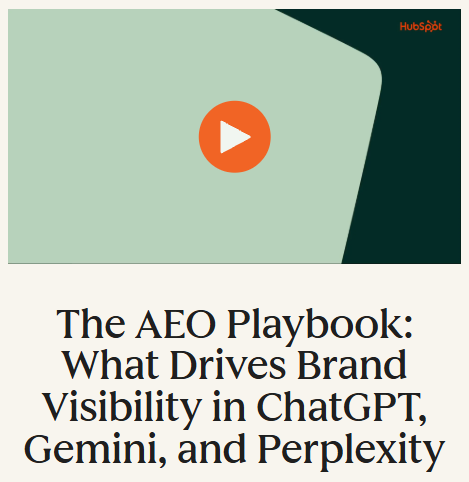
HUBSPOT recently conducted a webinar on this topic.
The brands most likely to succeed are the ones that help AI systems confidently answer human questions.
That means building clear entities, structured knowledge, topical authority, technical accessibility, external trust, and genuinely useful content ecosystems.
Search is evolving from ranking pages to synthesizing answers. And visibility is evolving with it.
Connect with our team if you are looking at exploring AEO for your business.