Imagine you’re walking through a busy market. Hundreds of shops line both sides of the road. Every shopkeeper is trying to get your attention.
- Some are shouting.
- Some have bright signs.
- Some are offering discounts.
- Some are simply waiting for customers to walk in.
Do you stop at every shop? Of course not. You glance. You scan.
You subconsciously decide what deserves your attention. The internet works exactly the same way.
Every day, your potential clients are scrolling through thousands of pieces of information:
- Google search results
- LinkedIn posts
- Instagram reels
- Emails
- YouTube videos
- Freelance profiles
- Advertisements
- Company websites
Every headline is competing for one scarce resource: Attention. And attention has become one of the world’s most valuable currencies.
We Don’t Read First. We Decide First.
One of the biggest misconceptions about readers is that they carefully evaluate every headline before deciding whether to click. They don’t.
Our brains are designed to conserve energy. If we analyzed every piece of information we encountered in a day in depth, we’d be mentally exhausted before lunch.
Instead, the brain uses shortcuts. Psychologists call these heuristics – mental rules of thumb that help us make quick decisions.
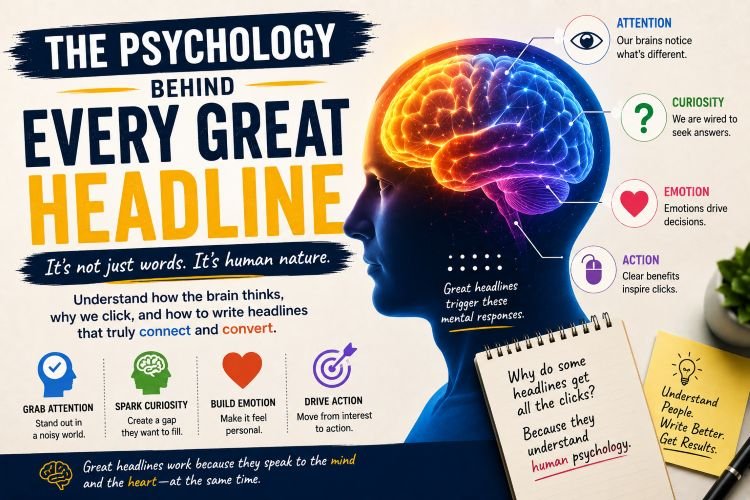
When someone sees your headline, their brain is unconsciously asking questions like:
- Is this relevant to me?
- Can this help me?
- Is it trustworthy?
- Is it worth my time?
- Is this something I’ve seen a hundred times before?
All of this happens in just a few seconds. Your headline isn’t competing against one other headline. It’s competing against everything else happening in your reader’s world.
The Three Seconds That Decide Everything
Think about the last time you searched Google. Did you carefully read all ten search results?
Or did your eyes jump from title to title until one felt right? That’s exactly what your clients do.
Whether they’re looking for:
- A web developer
- A graphic designer
- A copywriter
- A project manager
- A consultant
- A virtual assistant
…they’re making incredibly fast judgments. Those judgments aren’t always rational. Sometimes they choose the freelancer who simply explained their value more clearly.
The Curiosity Gap
One reason some headlines work better than others is that they create what psychologists often call a curiosity gap.
That’s the space between what someone knows and what they want to know.
For example:
Why Most Freelancers Never Hear Back From Clients
Immediately, questions appear in your mind.
- Why?
- Am I making the same mistake?
- Can I fix it?
You naturally want to know the answer.
Now compare it with:
Freelancing Tips
There’s no mystery. No reason to continue. No unanswered questions.
Curiosity is powerful because our brains dislike incomplete information.
However, and this is where many creators go wrong, curiosity should never become manipulation.
A headline that promises something extraordinary but delivers something ordinary doesn’t build trust. It destroys it.
Curiosity vs. Clickbait
There’s a fine line between encouraging curiosity and abusing it. Let’s compare a few examples.
Clickbait
You Won’t Believe This Freelancer’s Secret!
It creates curiosity. But it also feels vague and exaggerated.
Now compare it with:
The One Change That Doubled My Freelance Inquiry Rate
This also creates curiosity. But it sets a clear expectation. The reader knows what they’re likely to learn.
Good headlines create curiosity. Great headlines also communicate value.
Relevance Always Wins
Imagine these two headlines appear in your LinkedIn feed.
10 Ways to Improve Your Business
or
10 Proposal Mistakes That Cost Freelancers Their Best Clients
Which one would a freelancer click? The second. Not because it’s more dramatic.
Because it’s more relevant. People don’t pay attention to information. They pay attention to their information.
That’s why generic headlines struggle. Specific headlines feel personal.
The Brain Looks for Benefits, Not Features
This is one of the most important lessons every freelancer should understand.
Clients rarely buy features. They buy outcomes.
Let’s look at a few examples.
| Feature | What the Client Actually Wants |
|---|---|
| WordPress Website | More enquiries |
| SEO | More organic traffic |
| Copywriting | Higher conversions |
| Logo Design | A memorable brand |
| Social Media Management | More engagement and leads |
| Email Marketing | More repeat customers |
| Project Management | Predictable project delivery |
Now apply the same thinking to headlines.
Instead of writing:
Professional SEO Services
Try:
SEO That Helps Small Businesses Get Found on Google
The second headline doesn’t just describe the service. It explains the result.
The “What’s in It for Me?” Test
Every reader is silently asking one question.
“What’s in it for me?”
Your headline should answer that question as early as possible. Let’s test a few examples.
Example 1
Digital Marketing Consultant
Nothing wrong. But nothing exciting either.
Now try:
Helping Local Businesses Turn Website Visitors into Paying Customers
Now the benefit is obvious.
Example 2
Freelance Project Manager
Better:
Keeping Complex Projects on Time, On Budget, and Stress-Free
Again, the focus shifts from the freelancer to the client’s outcome. That’s a subtle change with a significant impact.
Emotion Influences Decisions
Many people believe business decisions are purely logical. Research in behavioral economics suggests otherwise.
People often make decisions emotionally and then justify them with logic. A business owner looking for a freelancer isn’t only thinking about cost.
They’re thinking:
- Will this person solve my problem?
- Can I trust them?
- Will they save me time?
- Will they reduce my stress?
- Will they make me look good to my boss or client?
Good headlines acknowledge those emotions without becoming overly dramatic.
Compare these:
Website Maintenance Services
versus
Never Worry About Your Website Breaking Again
The second headline speaks to relief. And relief is an emotional benefit.
Why Simplicity Beats Cleverness
Freelancers often try to sound impressive. They use industry jargon. Buzzwords. Creative phrases. Complex language.
Ironically, the more mental effort required to understand your headline, the less likely someone is to keep reading.
Imagine these two headlines.
Leveraging Innovative Digital Ecosystems for Scalable Business Transformation
versus
We Build Websites That Help Businesses Grow
One sounds intelligent. The other communicates. Communication always wins.
A Lesson From Everyday Life
Think about road signs. Imagine a sign that said:
Vehicular Momentum Reduction Zone Approaching
Now compare it with:
Speed Breaker Ahead
Which one would help you react faster? The second. Not because it’s smarter. Because it’s clearer.
Your headline should work the same way. If people have to decode it, you’ve already lost them.
Practical Exercise
Open your website, LinkedIn profile, or portfolio. Pick one headline.
Now ask yourself these questions:
- Does it immediately tell people who it’s for?
- Does it explain a benefit rather than a feature?
- Could a twelve-year-old understand it?
- Would I stop scrolling if I saw this?
- Is it specific enough to feel relevant?
- Does it promise something meaningful without exaggerating?
If you answered “No” to even two of these questions, don’t worry. That’s exactly why you’re reading this guide.
And by the end, you’ll have a structured process for rewriting every important headline you use.
What are the Key Takeaways
Before we learn how to write headlines, remember these principles:
- Your headline competes for attention, not awards.
- People decide before they read.
- Relevance beats cleverness.
- Benefits beat features.
- Curiosity should invite, not deceive.
- Simplicity creates clarity.
- Every headline should answer the reader’s silent question: “What’s in it for me?”
These ideas form the foundation of every effective headline, whether you’re writing a LinkedIn post, an Upwork proposal, a Google Ad, or the homepage of your freelance website.
Coming up in Part 3: The Anatomy of a Great Headline.
We’ll move from psychology to practice by breaking down the essential building blocks of headlines that consistently attract attention and inspire action. We’ll analyze real examples, identify what works (and why), and introduce a practical framework you can use every time you sit down to write.
As I was writing this post, one thought kept coming back to me: headlines are an act of empathy. The best ones don’t try to sound impressive – they show the reader that you understand what they’re trying to achieve. I think that’s a mindset worth carrying through the rest of this guide.
You can reach me on LinkedIn or continue reading to the next part.