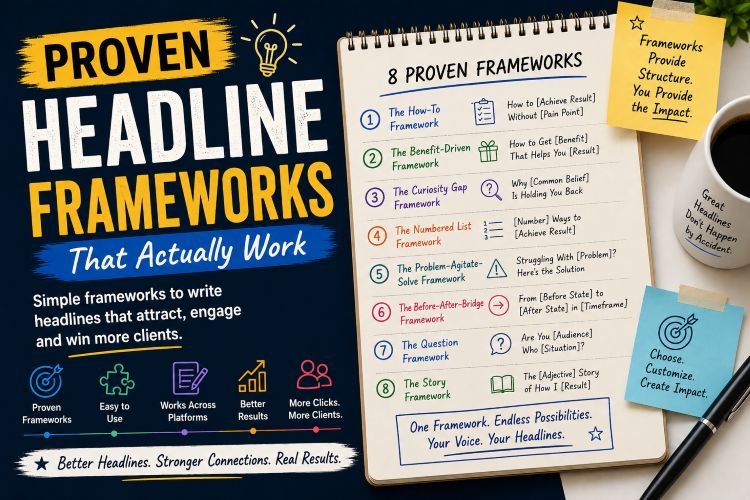
Think of a framework as the blueprint of a house. Experienced copywriters rarely start from scratch. They start with a headline framework.
So, one of the biggest myths about copywriting is that great writers stare at a blank page until inspiration strikes.
The blueprint doesn’t decide the paint color or the furniture. It simply provides a structure that has worked before.
Headline frameworks work the same way. They don’t remove creativity. They give it direction.
Let’s explore some of the most reliable frameworks you can adapt to your own work.
Framework 1 – The “How To” Formula
Structure
How to + Achieve a Desired Outcome
Why it works
People naturally search for solutions.
The phrase “How to” signals that practical guidance is coming.
That’s why it has remained one of the most effective headline formats for decades.
Best for
- Blog articles
- Tutorials
- YouTube videos
- LinkedIn articles
- Educational newsletters
Example
Instead of
Freelancing Guide
write
How to Land Your First Freelance Client Without Cold Calling
Framework 2 – The Number List
Structure
X Ways to…
Why it works
Numbers reduce uncertainty. Readers know exactly what they’re getting.
Best for
- Blog posts
- Email newsletters
- Social media
Example
15 Proposal Mistakes That Cost Freelancers Their Best Clients
Framework 3 – The Mistake Formula
Structure
X Mistakes That…
Why it works
People are naturally motivated to avoid mistakes.
Sometimes, avoiding failure is a stronger motivator than pursuing success.
Example
7 Mistakes That Make Clients Ignore Your Portfolio
Framework 4 – The Question
Structure
Ask the exact question your audience is already asking.
Example
Why Am I Not Getting Freelance Clients?
Notice something important. Don’t invent questions. Listen to the questions people actually ask.
Those usually become excellent headlines.
Framework 5 – The Benefit Formula
Structure
Outcome first.
Example
Instead of
Time Tracking Software
write
Track Every Billable Hour Without Micromanaging Yourself
The software isn’t the benefit. The outcome is.
Framework 6 – Before & After
Show the transformation.
Example
From Zero Clients to a Fully Booked Calendar: Lessons From My First Year Freelancing
People enjoy stories because they make success feel achievable.
Framework 7 – The Beginner’s Guide
Never underestimate beginners. Every expert was one once.
Example
A Beginner’s Guide to Freelancing in 2026
Simple. Clear. Approachable.
Framework 8 – The Complete Guide
This signals depth. Readers expect one resource that answers most of their questions.
Example
The Complete Guide to Building a Freelance Portfolio
Use this format only when your content truly is comprehensive.
Framework 9 – The Checklist
People love certainty.
Example
The Freelance Website Checklist Before You Hit Publish
Instantly practical.
Framework 10 – The Template Formula
Templates reduce effort.
Example
10 Proposal Templates That Save Freelancers Hours Every Week
Framework 11 – The Comparison
People compare before buying.
Examples
- Fiverr vs Upwork
- WordPress vs Webflow
- Freelancer vs Agency
A headline could be:
Fiverr vs Upwork: Which Platform Is Better for Beginners?
Framework 12 – The Myth Buster
Challenge common beliefs.
Example
Why Charging Less Doesn’t Help You Win More Freelance Clients
Contrarian headlines work because they interrupt assumptions.
But be careful – challenge ideas, not people.
Framework 13 – The Case Study
Real stories build credibility.
Example
How One Portfolio Change Increased My Client Enquiries
Specific stories often outperform broad advice because readers can see the journey.
Framework 14 – The Time Formula
People value speed.
Examples
- In 30 Days
- In One Week
- In 20 Minutes
Example:
How to Build a Professional Portfolio in One Weekend
Be realistic. Never promise results you can’t support.
Framework 15 – The Fear Formula
Used ethically, this highlights genuine risks.
Example
The Proposal Mistake That’s Costing You Clients
Notice the difference between informing and frightening. Your goal is to help, not manipulate.
Framework 16 – The Opportunity Formula
Focus on what’s possible.
Example
The Untapped LinkedIn Strategy Every Freelancer Should Know
Opportunity often feels more inspiring than urgency.
Framework 17 – The “Stop Doing This” Formula
Sometimes removing bad habits creates more value than adding new ones.
Example
Stop Sending Generic Freelance Proposals
Short. Direct. Actionable.
Framework 18 – The Blueprint
People like repeatable systems.
Example
The Blueprint I Use to Win Repeat Freelance Clients
Blueprint implies process, not luck.
Framework 19 – The Roadmap
Perfect for long-term journeys.
Example
A Roadmap From Beginner Freelancer to Full-Time Independent Professional
Readers know they’re about to follow a structured path.
Framework 20 – The Formula
People appreciate repeatable methods.
Example
The Five-Step Formula for Writing Proposals That Get Replies
Just make sure the formula is genuine and explained clearly.
Framework 21 – The “Why” Headline
Sometimes people don’t need instructions—they need understanding.
Example
Why Great Freelancers Still Struggle to Find Clients
This type of headline invites readers to rethink their assumptions.
Framework 22 – The “What If” Headline
These headlines encourage readers to imagine a possibility.
Example
What If Your Portfolio Worked While You Slept?
Used sparingly, this can spark curiosity without feeling exaggerated.
Framework 23 – The “Lessons Learned” Headline
Experience is valuable. Sharing lessons makes readers feel they’re learning from someone who’s already been through the journey.
Example
10 Lessons I Learned After Five Years of Freelancing
Framework 24 – The “Behind the Scenes” Headline
People are naturally curious about process.
Example
Behind Every Successful Freelance Proposal Is This Simple Research Process
This works well because it promises insight that isn’t immediately visible.
Framework 25 – The “One Thing” Headline
Sometimes simplicity is powerful.
Example
The One Habit That Improved Every Client Conversation
This format works best when the article focuses on a single key idea rather than trying to cover everything.
Choosing the Right Framework
Not every framework suits every situation. Here’s a quick guide.
| Goal | Good Frameworks |
|---|---|
| Teach a skill | How-To, Guide, Blueprint |
| Build trust | Case Study, Lessons Learned, Behind the Scenes |
| Generate curiosity | Why, What If, Myth Buster |
| Encourage action | Checklist, Stop Doing This, Formula |
| Compare options | Comparison |
| Attract beginners | Beginner’s Guide, Roadmap |
| Offer quick wins | Number List, Template, Time-Based |
Think of these frameworks as tools in a toolbox. A carpenter doesn’t use a hammer for every job, and you don’t need to use the same headline format for every piece of content.
A Word of Caution
Frameworks are starting points – not shortcuts.
If every blog post you publish is titled:
- 10 Ways…
- 7 Tips…
- 5 Secrets…
Your content starts to feel predictable.
Mix your formats. Surprise your readers. Choose the structure that best fits the value you’re delivering.
A memorable headline comes from understanding your audience, not from forcing every idea into the same mold.
Practice Exercise
Take one topic you’re planning to write about. For example:
“Creating a freelance portfolio.”
Now write five different headlines using five different frameworks.
- How-To: How to Build a Freelance Portfolio That Wins Better Clients
- Mistake: 7 Portfolio Mistakes That Drive Potential Clients Away
- Question: Is Your Freelance Portfolio Costing You New Business?
- Blueprint: The Blueprint for a Portfolio That Sells Your Skills
- Case Study: How I Improved My Portfolio and Started Getting Better Client Inquiries
Notice how the topic stays the same, but the angle changes. That’s the power of frameworks – they help you explore different ways of presenting the same value.
Key Takeaways
- Great copywriters don’t rely on inspiration alone; they rely on proven structures.
- A framework doesn’t guarantee a great headline – it’s the quality of your idea and the relevance to your audience that make it work.
- Choose a framework that matches your goal, not the latest trend.
- Always adapt a framework to your own voice and your audience’s needs.
A quick reflection before we move on
If you’ve followed the guided posts so far, you now have the psychology (Part 2), the building blocks (Part 3), and the frameworks (Part 4). That’s enough to write better headlines than many freelancers already publishing online.
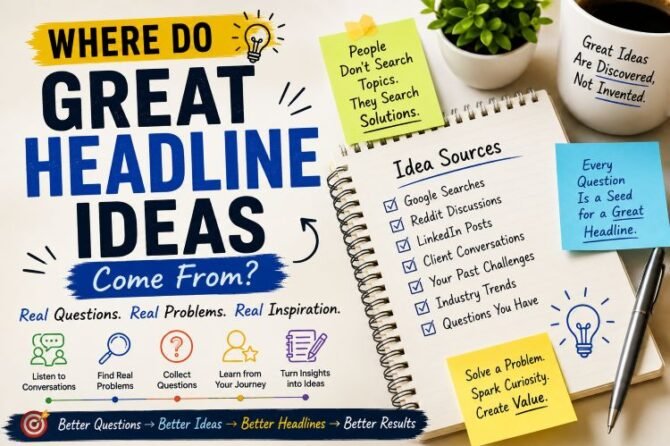
But in the next post, we’re going to tackle something that often matters even more: Where do great headline ideas come from?
Because the hardest part isn’t polishing a headline – it’s facing a blank page and wondering what to write.
And that’s exactly what we’ll solve next. Are you excited?
If you wish to connect with the author, you can reach him on LinkedIn.