Headline Style and Dressing Style – Imagine walking into a job interview wearing a wedding suit.
You look professional. Your clothes are expensive. Nothing is technically wrong. Yet something feels… out of place.
Now imagine wearing gym clothes to a wedding. Again, nothing is inherently wrong with the clothes. They’re simply not appropriate for the occasion.
Headlines work exactly the same way.
- A headline that performs brilliantly on Google may completely fail on LinkedIn.
- An email subject line that gets opened may look strange as a YouTube title.
- A Fiverr gig title follows different rules than a portfolio homepage.
The message isn’t necessarily wrong. It’s just wearing the wrong outfit.
One of the biggest mistakes freelancers make is using the same headline style everywhere.
Instead, learn to adapt your message to each platform’s expectations.
The Platform Shapes the Reader’s Mindset
Before writing any headline, ask yourself one question:
“Why is someone on this platform?”
The answer changes everything. Think about it.
- Someone searching Google is actively looking for an answer.
- Someone scrolling LinkedIn is discovering ideas.
- Someone checking email is deciding what deserves attention.
- Someone visiting your portfolio is evaluating whether they should trust you.
The reader changes. So should your headline; hence, headline style matters.
Google Search: Be the Best Answer
When people search Google, they’re usually trying to solve a problem. They’re not looking for entertainment.
They’re looking for clarity. Suppose someone searches: How to find freelance clients
Which headline feels more useful?
❌ The Secret to Freelancing Success
or
✅ How to Find Your First Freelance Client: A Practical Step-by-Step Guide
The second headline immediately tells the searcher:
- Yes, you’re in the right place.
- This article answers your question.
- Here’s what you’ll learn.
Google rewards relevance. Readers do too.
For Google, prioritize:
- Clear language
- Search intent
- Specific outcomes
- Honest promises
Don’t try to sound mysterious. Try to sound useful.
LinkedIn: Start Conversations, Not Just Clicks
LinkedIn is very different. People aren’t necessarily looking for answers.
They’re browsing between meetings. Checking updates. Learning from peers. Discovering new perspectives.
That means your headline should spark interest quickly.
Compare these.
❌ Project Management Best Practices
vs.
✅ The Best Project Plan I Ever Wrote Failed Miserably. Here’s What It Taught Me.
Which one would you stop scrolling for? Probably the second.
Why? Because stories create curiosity. LinkedIn rewards authenticity more than perfection.
Some of the most engaging posts begin with:
- A mistake
- A lesson
- An unexpected observation
- A personal experience
You’re not writing a textbook. You’re starting a conversation.
Portfolio Headlines: Build Confidence
Your portfolio isn’t trying to generate curiosity. It’s trying to build trust. That’s an important difference.
Many freelancers introduce themselves like this: Freelance Graphic Designer. Technically true.
But imagine walking into a bakery with a sign that simply says: Bread. You’d probably expect more.
Now consider: Helping Small Businesses Build Brands Customers Remember
Suddenly, the focus shifts. You’re no longer describing yourself. You’re describing the value you create.
A portfolio headline should answer one question: “Why should I hire you?”
Not through boasting. Through clarity.
Proposal Headlines: Make the Client Feel Understood
Many freelancers begin proposals with:
Dear Sir/Madam,
or
I am interested in your project.
The client already knows that. A better opening demonstrates understanding.
Imagine responding to a project that says:
Looking for a WordPress developer to improve website speed.
Instead of saying:
I’m an experienced WordPress developer…
try opening with:
I noticed your main concern is website speed and user experience. Here’s how I’d approach improving both without disrupting your live site.
See the difference? One talks about you. The other talks about the client’s problem.
Clients hire people who understand them. Not people who introduce themselves first.
Email Subject Lines: Earn the Open
An email has one challenge before anything else. It has to be opened. Your subject line doesn’t need to tell the entire story. It simply needs to make opening the email feel worthwhile.
Compare these.
❌ Website Proposal
vs.
✅ Three Ideas to Improve Your Website’s Lead Generation
The second headline immediately offers value. Whether the recipient agrees or not, they’re more likely to be curious.
Keep email subject lines:
- Concise
- Relevant
- Personal where appropriate
- Honest
Never trick people into opening an email. Trust is much harder to earn the second time.
Google Ads: Every Character Matters
Writing Google Ads teaches one valuable lesson: Every word has a cost. You don’t have unlimited space.
Every character must justify its place.
A weak headline: Professional SEO Services
A stronger headline: Local SEO That Helps You Get More Customers
Notice that the second one doesn’t use bigger words. It uses better words. If you can communicate your value in less characters, you’ve learned an incredibly valuable copywriting skill.
Fiverr and Upwork: Match the Buyer’s Search
Freelancers often try to sound unique. Ironically, being too creative can make you invisible.
Imagine someone searches:
WordPress Speed Optimization
Now compare these gig titles.
❌ Making the Internet Faster
vs.
✅ I Will Optimize Your WordPress Website for Faster Loading Speed
The first sounds creative. The second matches exactly what the buyer is searching for. Creativity has its place. Searchability comes first.
YouTube: Curiosity Meets Clarity
A YouTube title has a different job. It competes with dozens of videos on the same topic. The challenge isn’t only attracting clicks. It’s attracting the right clicks.
For example:
❌ Freelancing Tips
vs.
✅ I Tried 10 Ways to Find Freelance Clients – Only 2 Actually Worked
Now there’s a story. A promise. And a reason to watch. The title creates curiosity without hiding the topic.
Social Media: Stop the Scroll
Whether you’re on Instagram, X, Threads, or Facebook, the challenge is similar. People weren’t looking for your post. Your headline has to interrupt their scrolling without feeling forced. One way to do that is to begin with an observation.
For Example: “The biggest mistake freelancers make isn’t charging too little.“
Immediately, readers begin wondering: Then what is it?
You’ve earned their attention. Now your content has a chance.
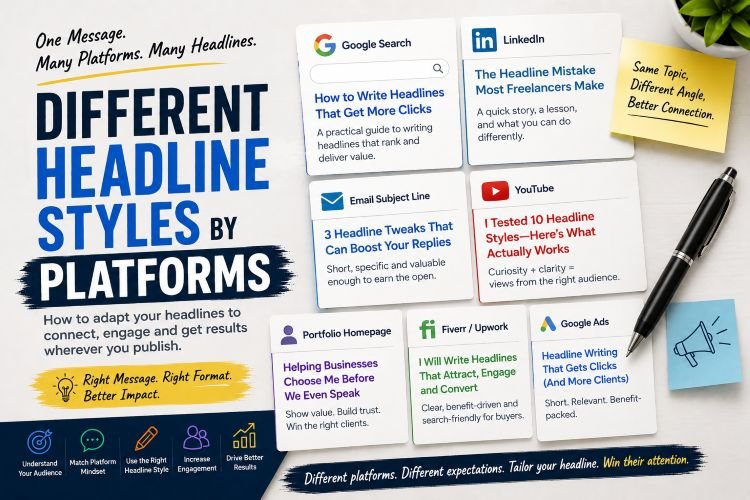
One Message, Many Headlines
Let’s see how the same core idea changes across platforms.
The topic:
Building a Freelance Portfolio
| Platform | Headline |
|---|---|
| How to Build a Freelance Portfolio That Wins Better Clients | |
| I Thought My Portfolio Was Good—Until a Client Ignored It | |
| Portfolio Homepage | Helping Businesses Choose Me Before We Even Speak |
| Three Portfolio Changes That Could Improve Client Enquiries | |
| Google Ads | Portfolio Review for Freelancers |
| Fiverr | I Will Build a Professional Freelance Portfolio Website |
| YouTube | I Reviewed 25 Freelance Portfolios—Here’s What They All Got Wrong |
Same topic: Different Audience. Different Mindset. Different Headline.
The Universal Principle
Every platform has different rules. But one principle never changes.
Your headline should make the reader think:
“This is exactly what I needed.”
Not:
“This sounds clever.”
Helping beats impressing. Every time.
Practice Exercise
Choose one service you offer. Now write six headlines for it.
One for:
- Your portfolio
- An email subject line
- Fiverr or Upwork
- YouTube
Don’t change the service. Change the way you introduce it. You’ll quickly discover that writing isn’t about repeating the same message. It’s about adapting it to the reader’s situation.
So Lets Look At TheKey Takeaways
- Great headlines are contextual.
- Different platforms create different expectations.
- Match the reader’s intent before trying to grab attention.
- Speak the language of the platform without losing your own voice.
- The same idea can be introduced in many different ways.
- Don’t copy and paste headlines across platforms—adapt them.
The best freelancers don’t just communicate well. They communicate appropriately. And that’s often what separates a message that gets ignored from one that earns a response.
A Reflection Before We Move On
I’d like you to notice something we’ve quietly been doing throughout this guide.
We haven’t really been talking about headlines. We’ve been talking about understanding people.
Headlines are simply where that understanding becomes visible. The better you understand your audience, the less you’ll worry about finding the “perfect words.”
You’ll naturally choose words that make sense to them. And that’s a skill that extends far beyond copywriting. It makes you a better freelancer, consultant, marketer, leader, and communicator.
Coming Up Next: Part 7 – AI Won’t Replace Great Headline Writers (But It Will Change How They Work)
This is the post I’m most excited about because it addresses the question every freelancer is asking in 2026:
“If AI can generate 100 headlines in seconds, what value do I still bring?”
My answer is simple: More than ever. And I’ll explain why. Read the Post Here.
In case you want to connect with the author, reach him on LinkedIn.