
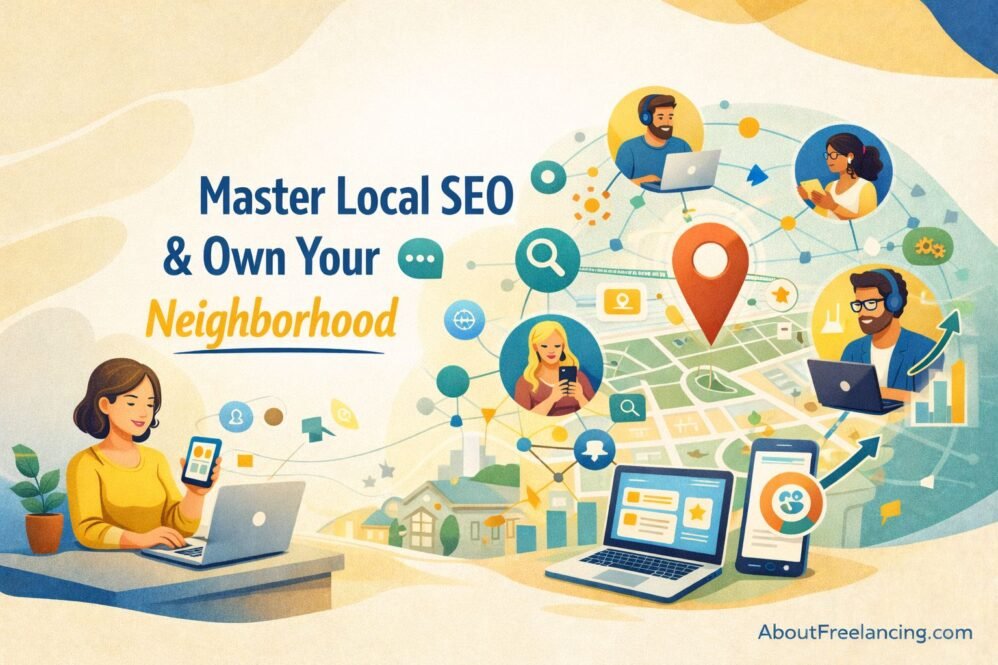
Local SEO is one of the most cost-effective visibility tools available to small businesses. But here’s a hard truth most small business owners don’t want to hear: if your business doesn’t show up on the first page of Google when someone searches for what you do in your city, you might as well be invisible. Your potential customer has already clicked on your competitor.
The good news? Local SEO is one of the most cost-effective visibility tools available to small businesses – and most owners are leaving it completely untouched.
What is local SEO, really?
Local SEO (Search Engine Optimisation) is the process of making sure your business shows up when people nearby search for your products or services. When someone Googles “best bakery near me” or “affordable plumber in [your city],” local SEO determines whose name pops up first.
Unlike broad SEO that competes on a global scale, local SEO is a winnable game for small businesses – because you’re only competing with the businesses in your area.
Step 1: Claim and optimise your Google Business Profile
If you’ve done nothing else, do this today. Your Google Business Profile (formerly Google My Business) is the single most powerful free tool for local visibility. It’s what shows up in the map pack – those three businesses that appear with a map when someone searches locally.
To optimise your profile:
- Make sure your business name, address, and phone number are 100% accurate and consistent with what appears on your website and social media.
- Choose the most specific category that describes your business.
- Upload at least 10 high-quality photos of your space, products, or team.
- Write a compelling business description using the keywords your customers actually search for.
- Add your business hours – and keep them updated during holidays.
Step 2: Get serious about reviews
Reviews are the lifeblood of local SEO. Google rewards businesses with frequent, genuine reviews by ranking them higher in local search results. More importantly, customers trust reviews more than any ad you could run.
The simplest strategy? Just ask. After a positive interaction, send a follow-up text or email with a direct link to your Google review page. Most happy customers are glad to help – they just need a nudge and a frictionless path.
Respond to every review, positive and negative. A thoughtful response to a bad review shows prospective customers that you care.
Step 3: Build local content on your website
Your website needs to speak the language of your city. This means including your city name naturally in your page titles, headings, and content. Consider writing blog posts that answer locally relevant questions – “What to look for in a [service] in [city]” or “How [your industry] works in [your neighbourhood].”
You should also aim to get listed in local directories: Yelp, the Better Business Bureau, your local Chamber of Commerce website, and any industry-specific directories relevant to your niche. Each listing creates a citation – a signal to Google that your business is real, trusted, and located where you say it is.
The compounding effect
Local SEO doesn’t produce overnight results, but it compounds. A business that consistently earns reviews, updates its profile, and builds local content over 6 -12 months can find itself permanently anchored at the top of local search results – without paying for a single ad.
Your action step this week: Log into Google Business Profile, review every section, and send a review request to your five most recent satisfied customers. Small steps, big returns.
Go back to: Six Innovative Ways to Improve Visibility as a Small Business Owner